We Are Scared Of What Makes Us Relevant: ACCOUNTABILITY
(And, Ironically, It’s Our Best Defense Against AI Takeover)
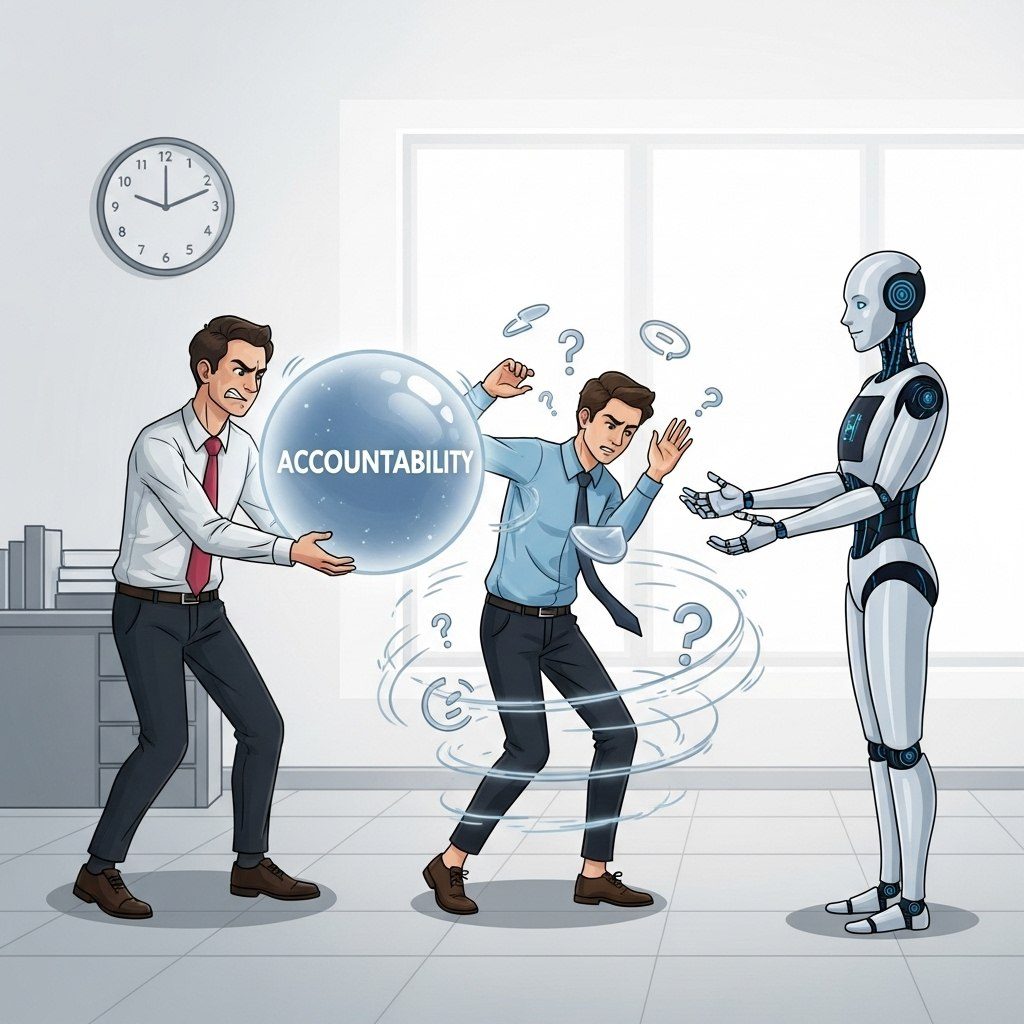
The latest wave of AI has everyone feeling a little… twitchy. They are shockingly capable, automating tasks we once thought were safely human. But in our rush to ponder what parts of our jobs AI will gobble up, we are overlooking the one thing it can't touch. The one thing that, ironically, we often run from like it’s a tiger in the breakroom: Accountability.
While we worry about being replaced by machines, the real threat might be our own reluctance to stand up and say, "I own this."
The AI Trust Paradox: Machines Need a Human Hand to Hold
AI by its very nature is not trustworthy.
AI models can hallucinate facts, produce biased outcomes, generate false positive/negative output, and simply get things wrong. They operate on algorithms and data, lacking intention, morality, or the capacity for genuine responsibility[1]. This is why the concept of "Trustworthy AI" is less about making the AI itself a paragon of virtue and more about wrapping it in a system of human oversight. As other tech leaders have pointed out, there is no trustworthy AI without human accountability[2].
Yes AI generates neat reports, great decision recommendations, and incredible research findings. At the end of the day, someone has to have the final say and declare, "I have checked this, I stand by it, and I am accountable for the outcome." An attributable source of human answerability should be ascribed to judgments assisted or generated by an AI system[3].
That act of ownership is what transforms a machine's probabilistic output into a trusted business decision.
This is the essence of the "human-in-the-loop" model[4]. We are not just there to catch errors; we are the source of trust in a world of increasingly automated workstreams.
This role as the anchor of trust directly reshapes our professional DNA. Our value proposition is no longer about simple execution, now is more about accountable ownership. This changes the very calculus for why a company would choose a person over a program, rebooting the primary reasons (I found so far) an organization will hire (and keep) a human in the age of AI:
- To Be the AI Orchestrator
An individual contributor or team manager, acting as the conductor. Manage works & AI outputs, and/or a hybrid team of human experts and specialized AI agents, weaving their outputs into a coherent, valuable deliverable.
- To Be the Accountability Holder
This is the big one, especially for leadership. C-suite and high-level management roles exist to take ultimate accountability for performance and strategic direction (hard to imagine a machine will go to shareholder meetings and take the blame for a share price drop).
- To Do What AI Cannot (Yet)
This includes skilled physical labor like plumbing or nuanced, deeply empathetic roles. In these jobs, accountability is naturally baked in (the person doing the work is fully responsible for it).
But this very evolution of our professional DNA forces a confrontation with one of our oldest workplace instincts: the reflexive dodge of true ownership.
The Accountability Void: A Tale of Workplace Woe
This instinct for self-preservation manifests in a scene we all know too well: the project lost in a thick fog of good intentions and verbal handshakes. That critical cross-team initiative kicks off, but key responsibilities remain conveniently vague. No one dares to document the details (where the devil famously resides) or put a name in writing next to a deliverable. Action items float like specters through the ether of unrecorded meetings, with a collective, unspoken hope that someone else will have the courage to grab them.
This behavior creates an "accountability void." A defense mechanism, our very human impulse to keep things fuzzy to shield our egos from the harsh spotlight of potential failure[5]. When roles are ambiguous, it is remarkably easy to evade responsibility for setbacks. This tendency is so predictable, in fact, that project management frameworks like the RACI Matrix[6] exist for one reason: to act as a floodlight of clarity, forcing ownership where it would otherwise evaporate.
This avoidance of ownership was, for decades, a familiar dynamic within our organizations (frustrating for some, certainly, but rarely fatal to one's career). However, the arrival of AI revolution fundamentally alters the return on managerial effort, making this flaw unsustainable for anyone who embodies it.
It presents leaders with a brutally simple cost-benefit analysis. When the managerial energy spent commanding a person to take ownership exceeds the minimal effort of prompting a machine to do the work, the human becomes a bad investment.
The logical outcome: The individual who consistently requires more management than they provide value is no longer a viable asset. They are an operational drag, and their role can be reallocated to a more efficient alternative.
So, as we navigate this new automated world, the path to remaining indispensable is not about out-working the machines. It is about embracing the one thing they will never have: the deeply human and newly powerful act of being accountable.
References
[1] https://www.runsensible.com/blog/human-ai-accountability-equally-law/
[2] https://www.ibm.com/think/insights/trust-in-ai-requires-human-accountability
[3] https://aiethics.turing.ac.uk/modules/accountability/?modulepage=part-one-introduction-to-accountability
[4] https://www.bigdatawire.com/2024/08/12/why-keeping-humans-in-the-loop-is-critical-for-trustworthy-ai/
[5] https://medium.com/@liam.patterson/from-blame-to-accountability-the-psychology-of-why-we-avoid-taking-responsibility-8d2c844a97d7
[6] https://project-management.com/understanding-responsibility-assignment-matrix-raci-matrix/